A concept map shows ideas as boxes and how they relate as labelled arrows, so every link reads as a sentence: "photosynthesis needs light energy", "glucose stores chemical energy". Teachers use concept maps to check understanding, students use them to revise, and writers and teams use them to see how the parts of a topic depend on each other.
Below are 9 concept map examples for biology, earth science, history, writing and business. Each one was made with Eidora's concept map maker from the short text shown under it: some from a single topic, others from a student's notes, a list of terms or an essay plan. Press Use this text under any example to open the maker with that text, change it, and get your own map in under 30 seconds.
Make your own concept map
Type a topic, or paste your notes or a list of terms. The concept map maker opens with your text in its box; press Generate there to draw it.
免费试用:不注册每天可以画一张图。
How to Read These Concept Map Examples
The main concept is the dark box at the top. The map reads from the top down, from the most general idea to the most specific.
Every arrow carries a verb or a short phrase. Read the box, the arrow and the next box together as one sentence: "Plate boundaries include convergent boundaries".
Most concepts hang under one more general concept, which keeps the map tidy and easy to follow.
A few cross-links join different branches. They are the most important part of a concept map, because they show how ideas from different parts of the topic connect. A list or an outline cannot show them.
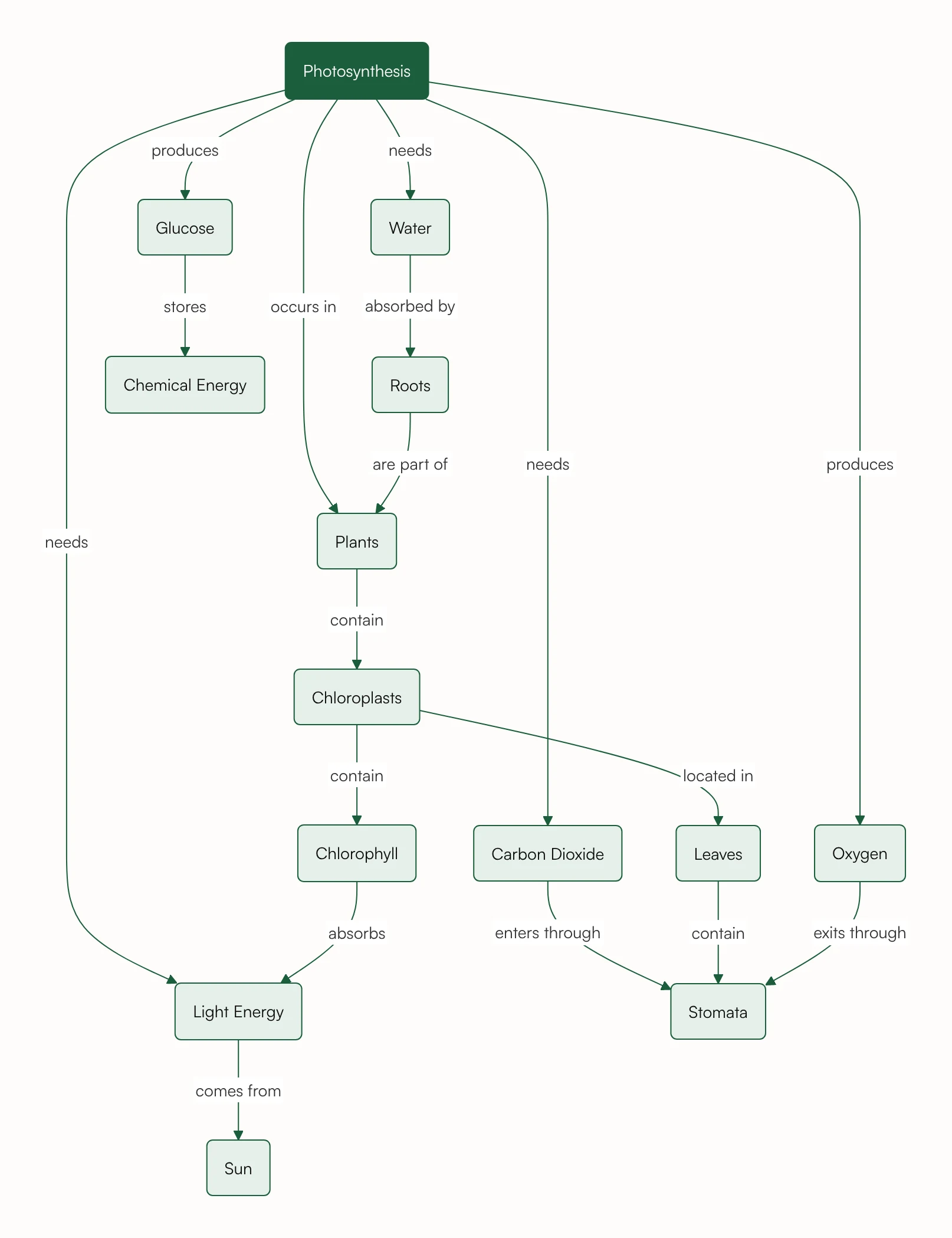
The classic science concept map. Photosynthesis needs light energy, water and carbon dioxide, produces glucose and oxygen, and occurs in plants, whose chloroplasts contain chlorophyll. The cross-links at the bottom are where the understanding shows: chlorophyll absorbs the light energy, and carbon dioxide enters and oxygen leaves through the stomata.
This map was made from a single word. Given only a topic, the maker draws the map a teacher would draw, using well-established facts. Check it against your course before you hand it in.
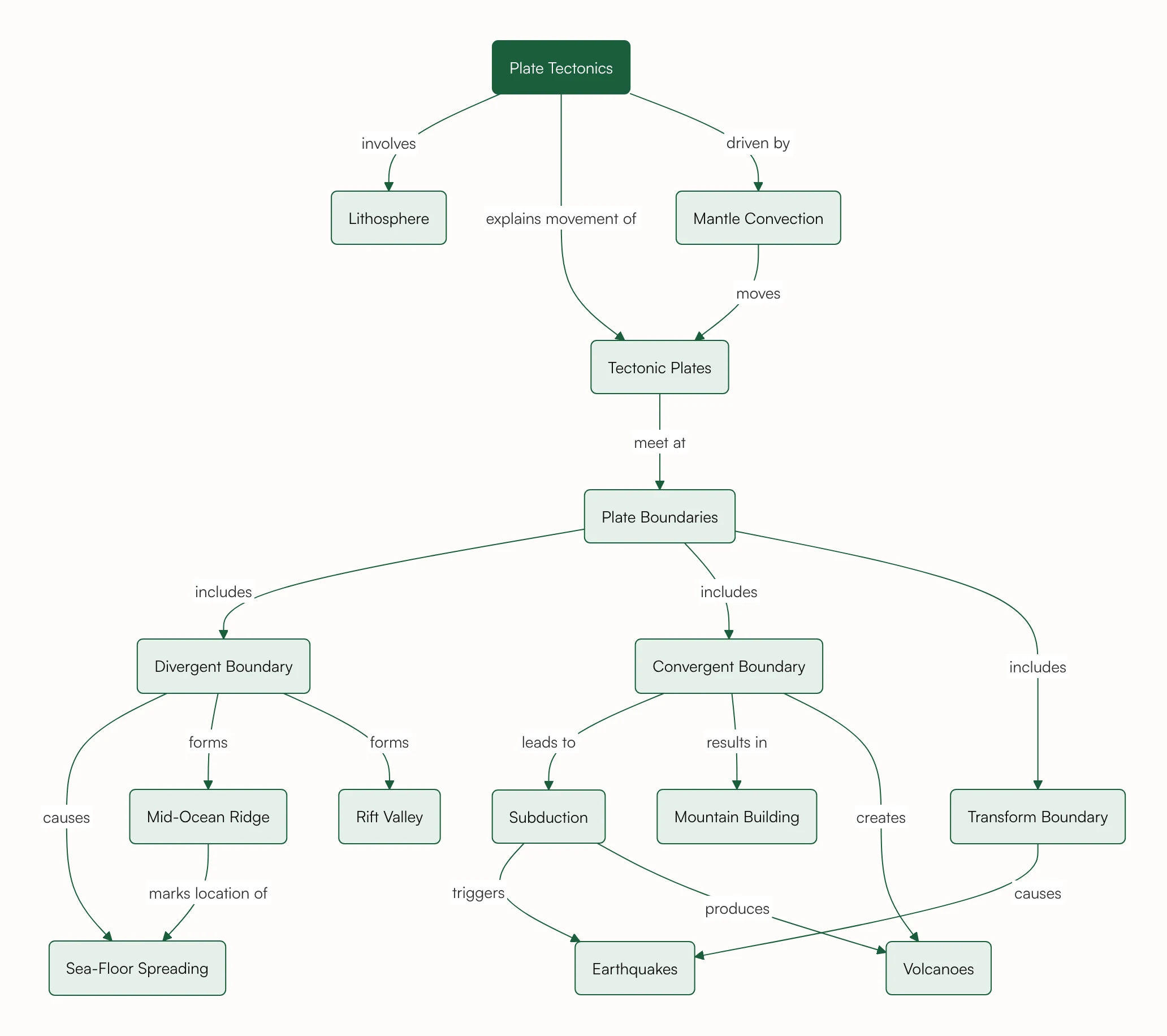
This map reads like a lesson from top to bottom. Plate tectonics is driven by mantle convection, which moves the tectonic plates; the plates meet at boundaries, and each kind of boundary has its own results. Divergent boundaries form mid-ocean ridges and rift valleys, convergent boundaries lead to subduction and mountain building, and transform boundaries cause earthquakes.
Notice that earthquakes and volcanoes each have two arrows coming in. Two different processes can cause the same result, which a list of facts would never show.
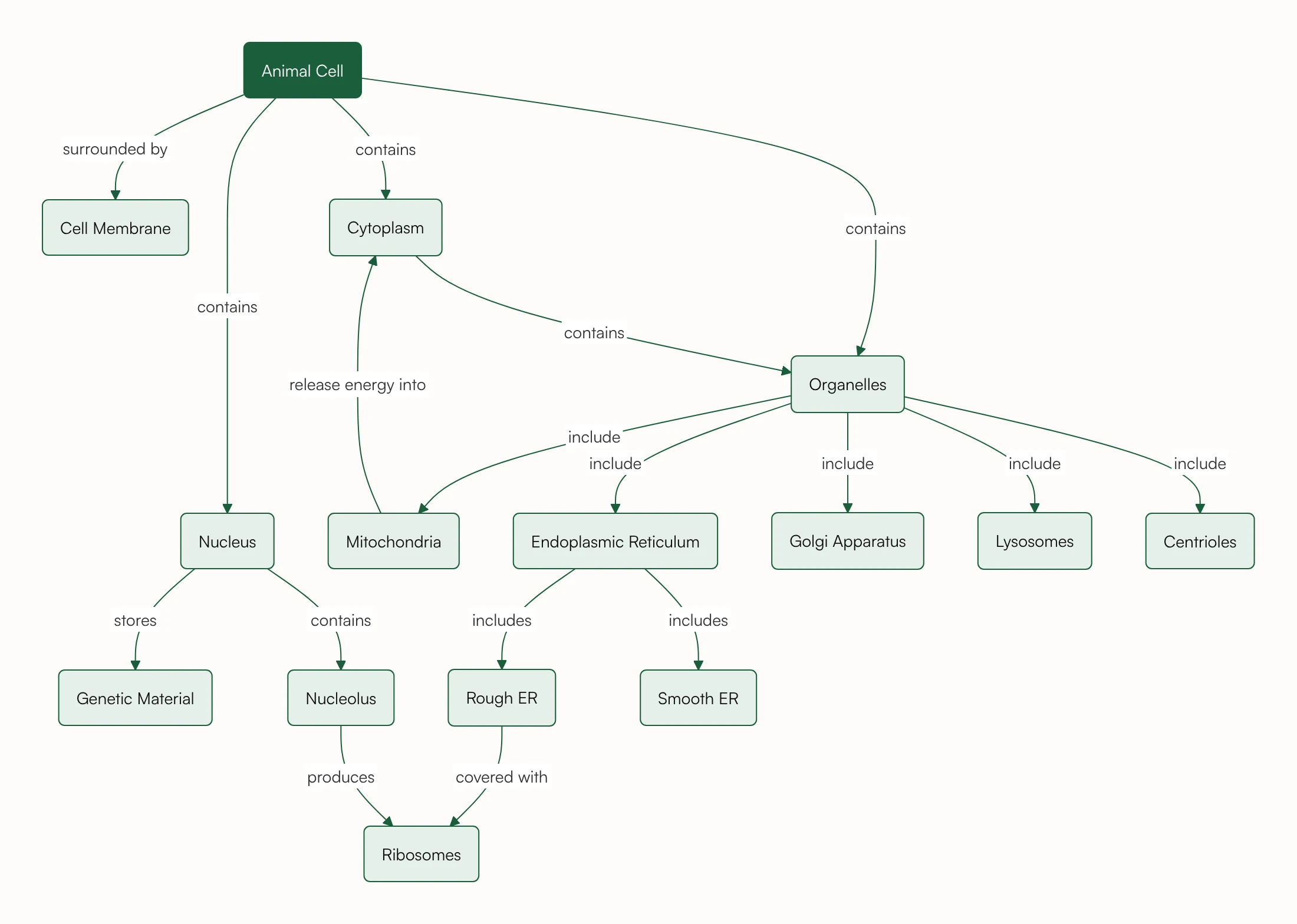
A structure map. The animal cell is surrounded by the cell membrane and contains the nucleus, the cytoplasm and the organelles, and each part sits under the group it belongs to: the nucleolus and the genetic material under the nucleus, the rough and smooth endoplasmic reticulum under the ER.
The cross-links add function to structure: the nucleolus produces ribosomes, the rough ER is covered with them, and the mitochondria release energy into the cytoplasm. Those are the links an exam question is most likely to ask about.
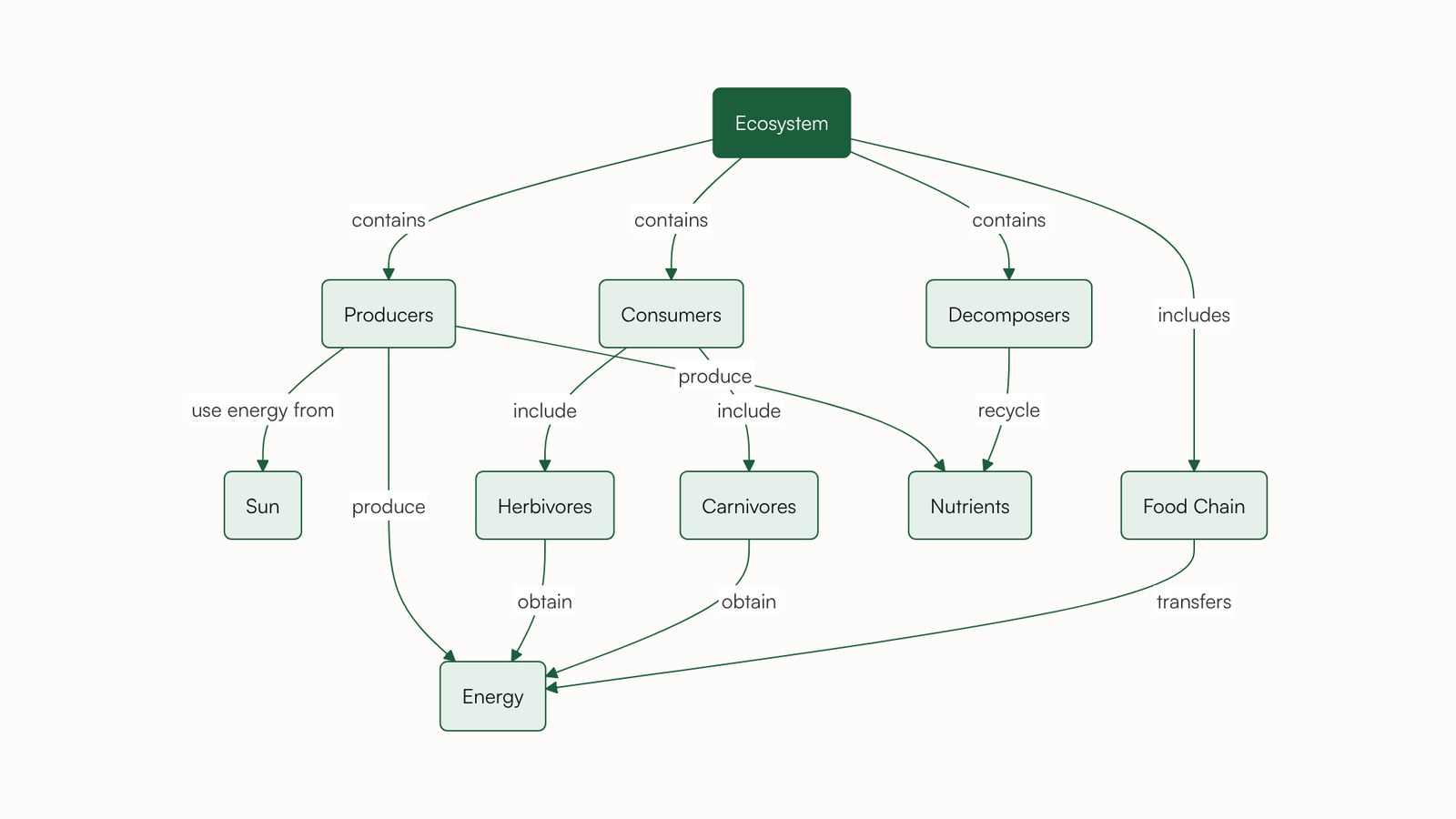
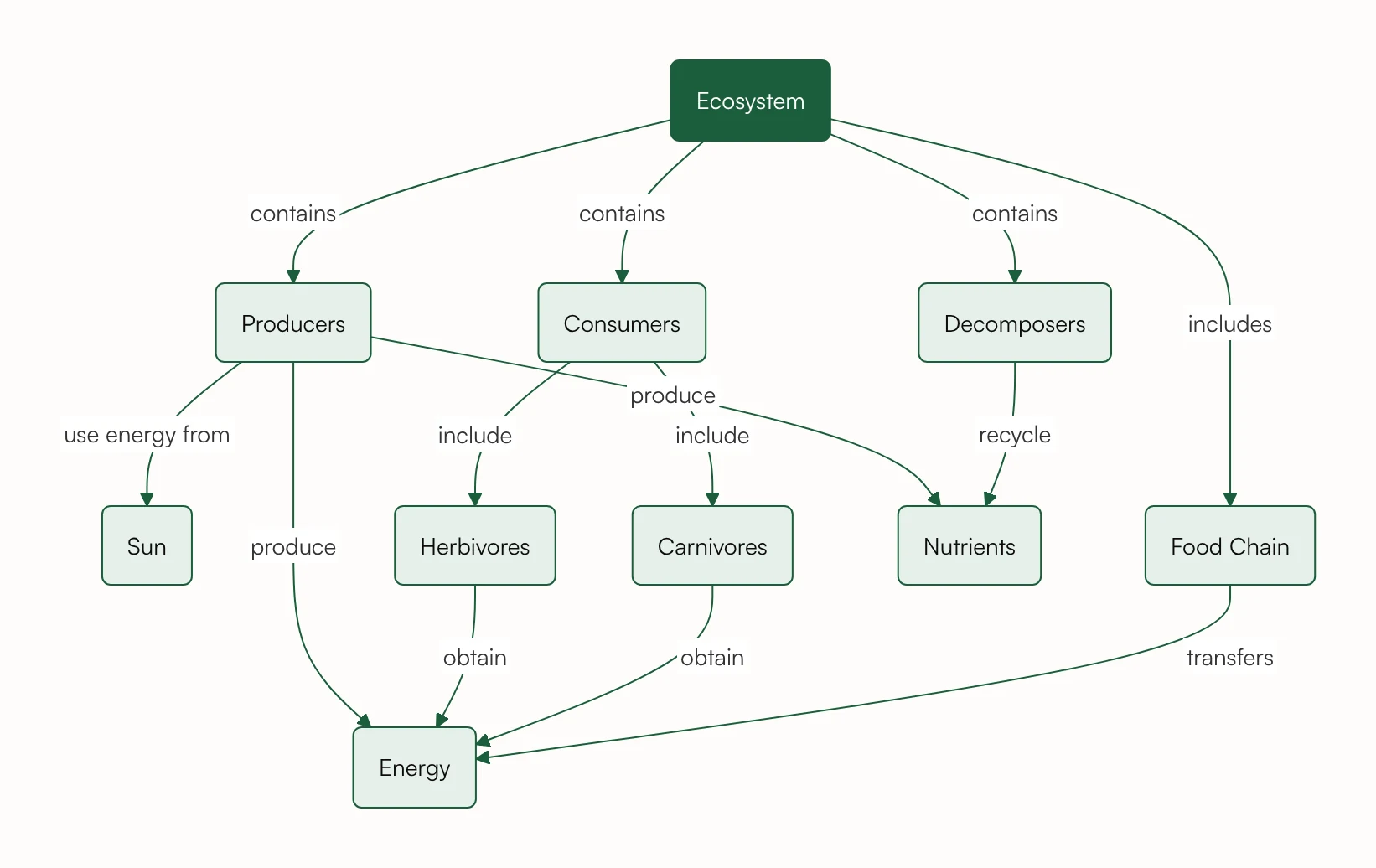
A common assignment: here are ten terms, connect them. This map was made from exactly that list and uses only those ten words. The ecosystem contains producers, consumers and decomposers; producers use energy from the sun; herbivores and carnivores, the two kinds of consumer, both obtain energy, which the food chain transfers; and decomposers recycle nutrients.
When you are given terms to connect, the links are what you are graded on. Read each arrow aloud and ask whether the sentence is true.
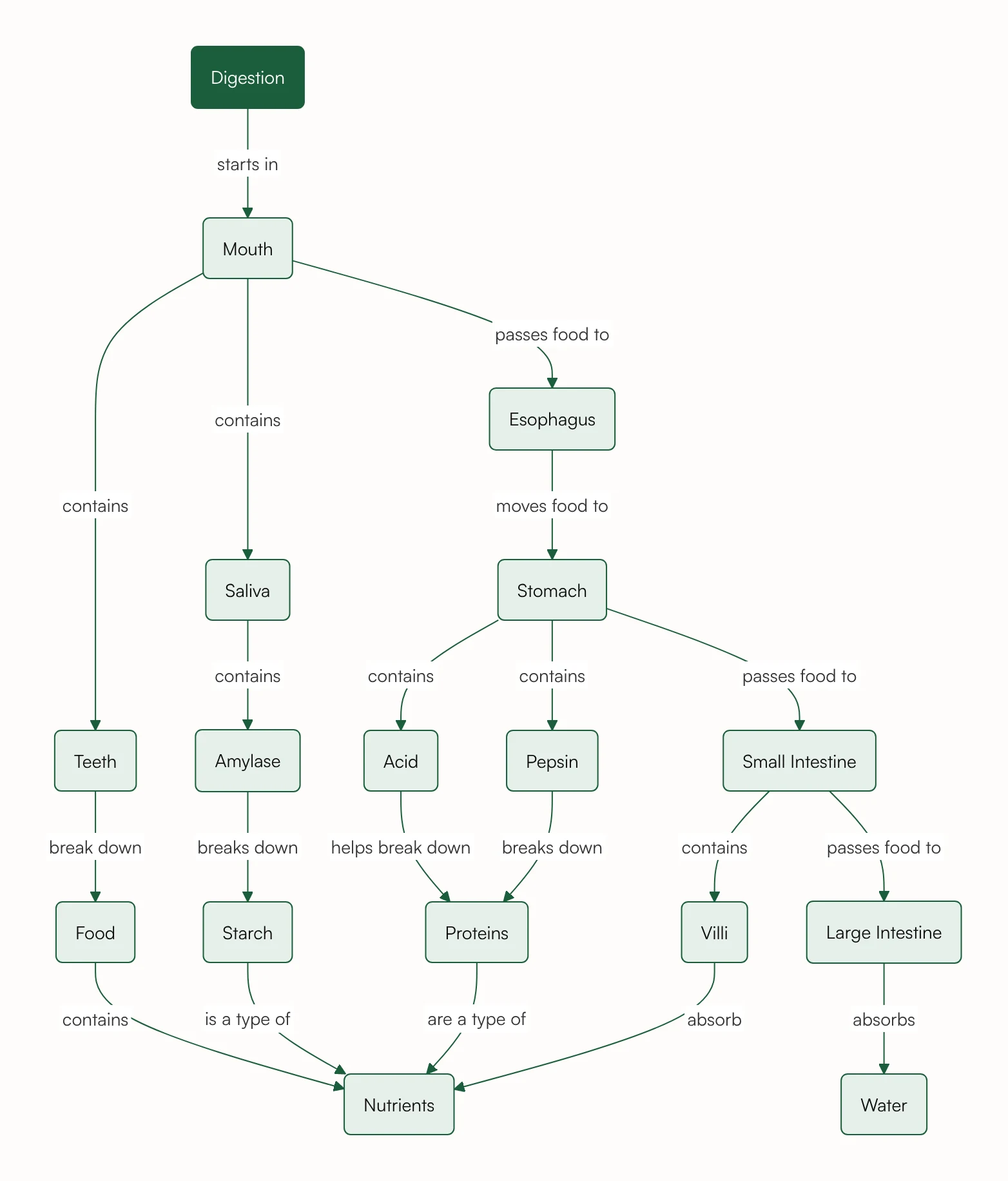
A map made from a student's own notes, shown below. Every concept comes from the notes, in the order food travels: mouth, esophagus, stomach, small intestine, large intestine. Under each organ are what it contains and what it does: saliva contains amylase, which breaks down starch; acid and pepsin break down proteins; villi absorb nutrients; the large intestine absorbs water.
The links at the bottom join food, starch and proteins to nutrients, the connection the notes imply without saying it. Turning your notes into a map like this is one of the best ways to revise: cover the words on the arrows and say them out loud.
画这张图用的文字
My biology notes: Digestion starts in the mouth, where teeth break food down and saliva contains amylase, which breaks down starch. The esophagus moves food to the stomach. The stomach uses acid and pepsin to break down proteins. Most nutrients are absorbed in the small intestine through villi. The large intestine absorbs water.
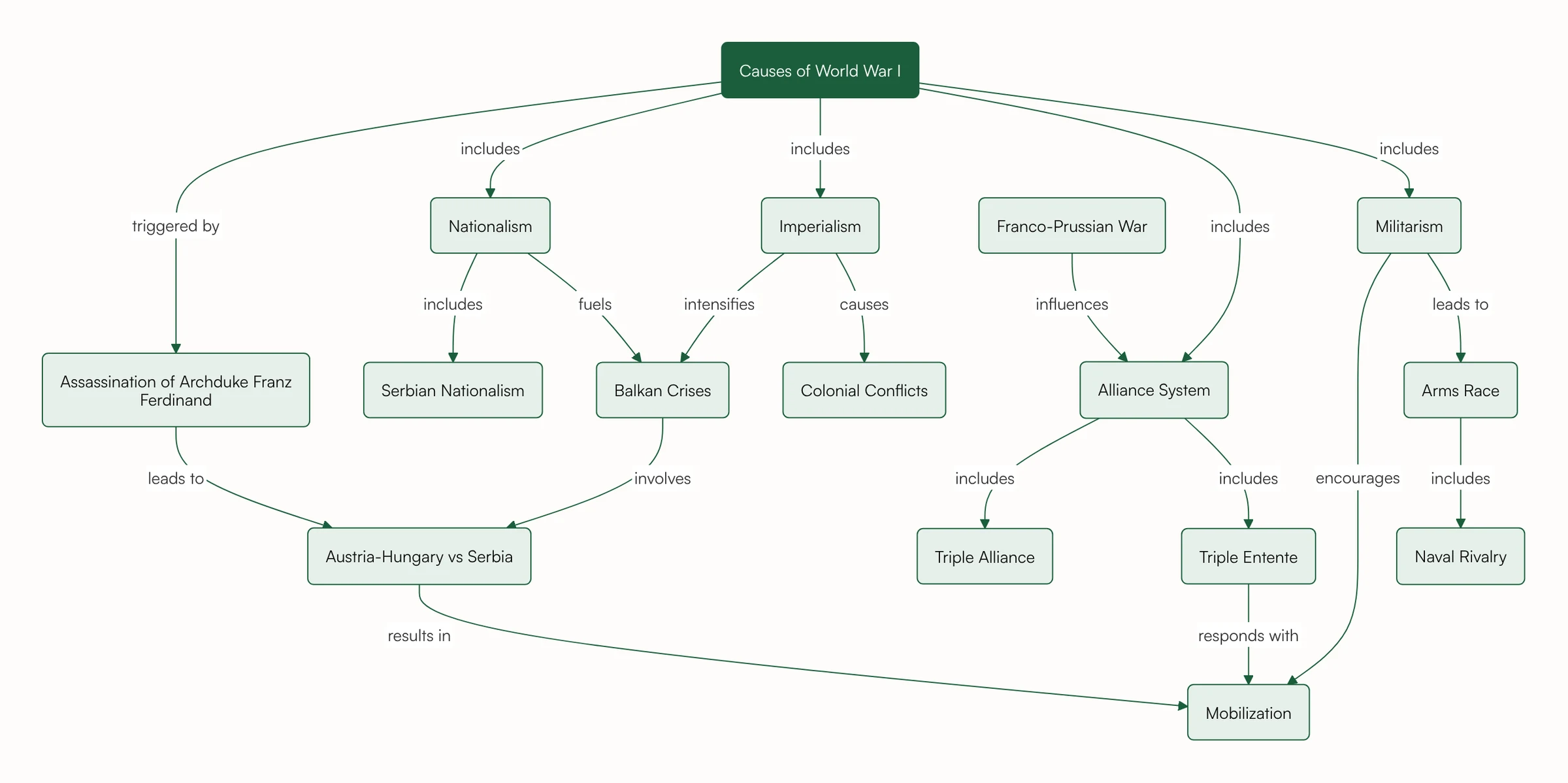
History concept maps link causes to events. The four long-term causes, militarism, the alliance system, imperialism and nationalism (often remembered as MAIN), sit under the main concept, with the assassination of Archduke Franz Ferdinand as the trigger.
The cross-links show how the causes fed each other: nationalism fuelled the Balkan crises and imperialism intensified them, the crises and the assassination led to the conflict between Austria-Hungary and Serbia, and that conflict, encouraged by militarism, resulted in mobilization.
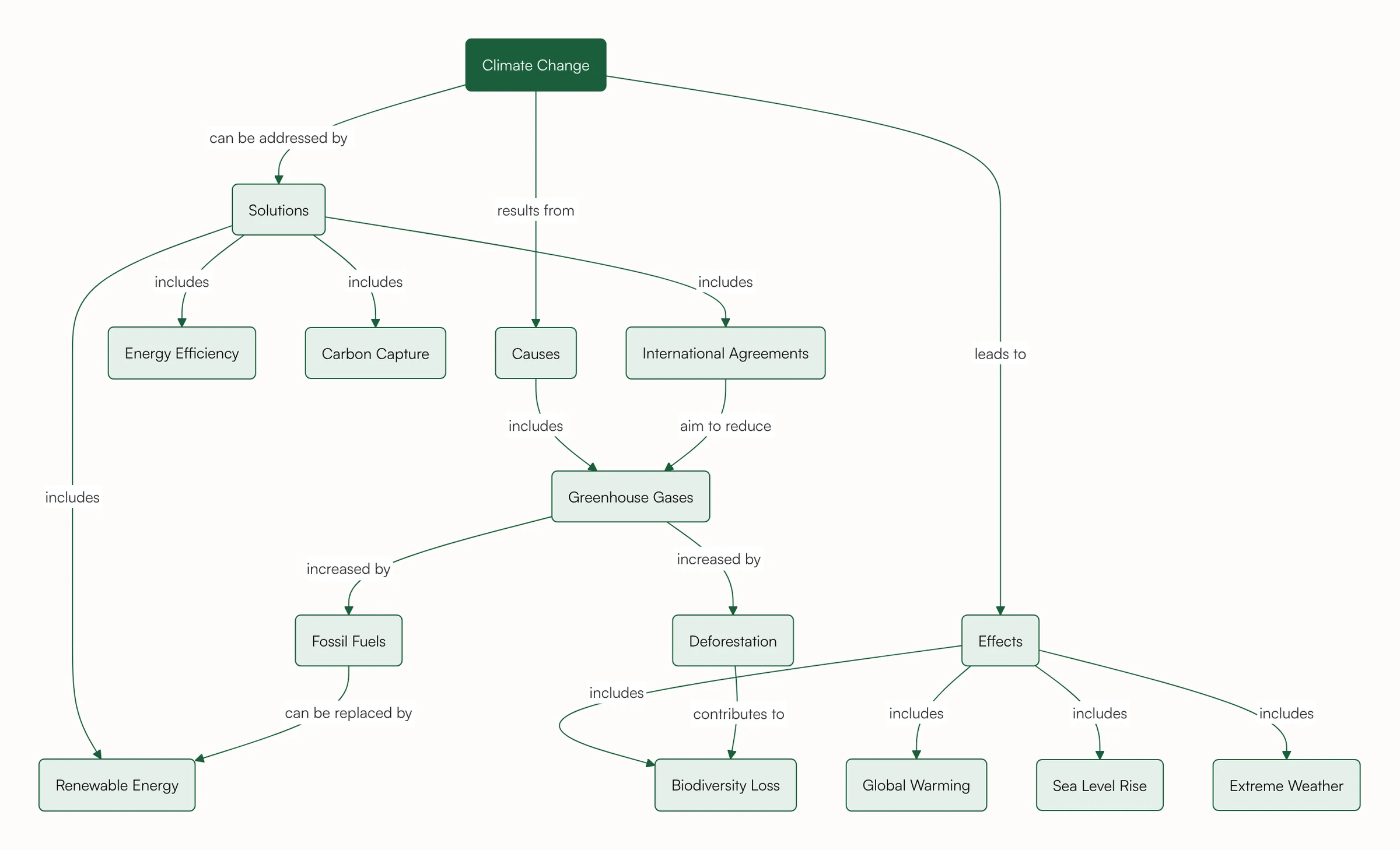
Grouping concepts under a few headings keeps a big topic readable. This map puts causes, effects and solutions straight under climate change, then fills in each group: greenhouse gases increased by fossil fuels and deforestation; global warming, sea level rise, extreme weather and biodiversity loss; renewable energy, energy efficiency, carbon capture and international agreements.
The cross-links connect the groups: renewable energy can replace fossil fuels, international agreements aim to reduce greenhouse gases, and deforestation contributes to biodiversity loss.
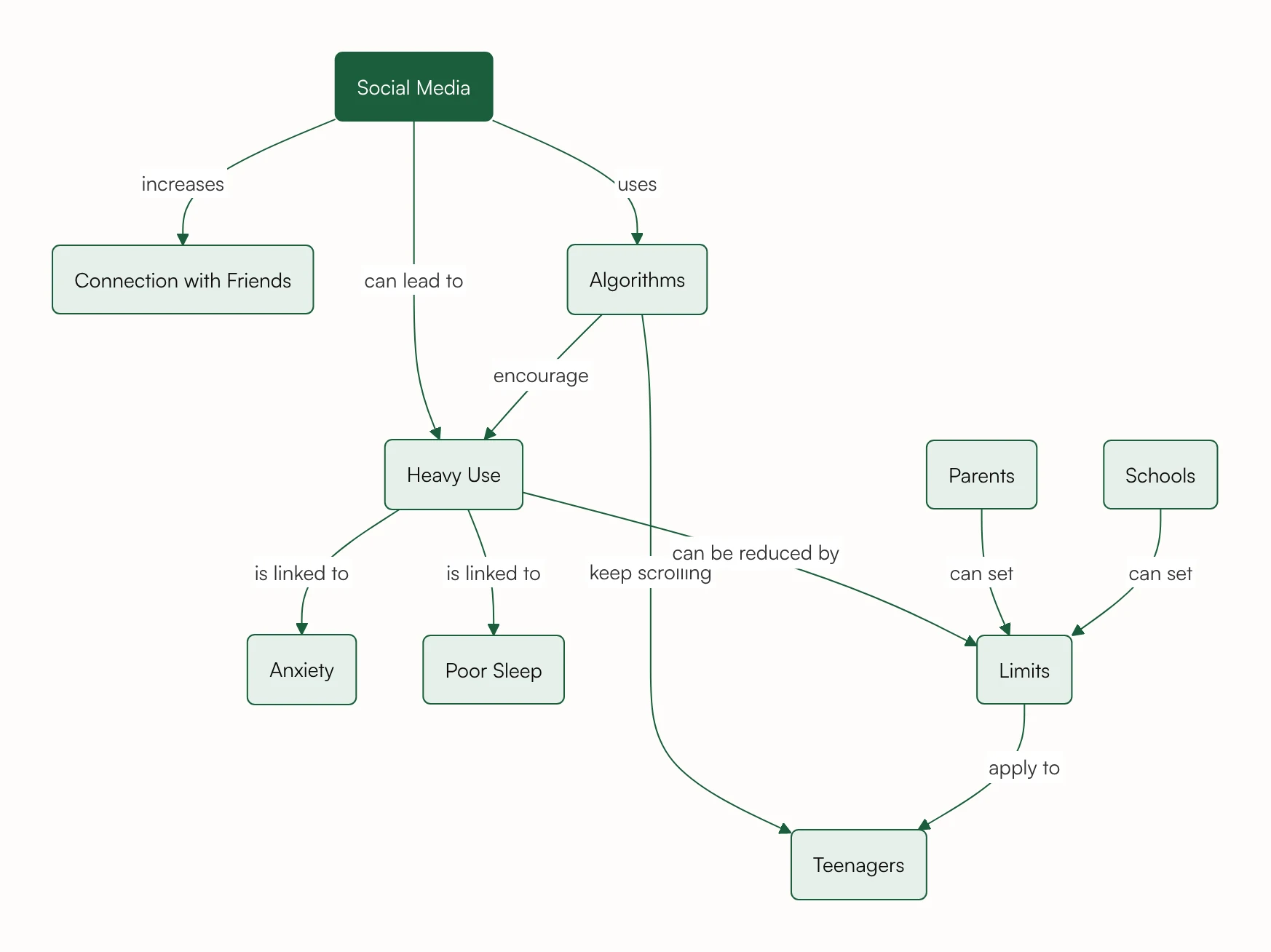
Before writing an essay, a concept map shows how your points connect and where your argument has gaps. This one was made from a four-sentence plan for an essay on social media and teenagers.
The map makes the argument visible. Heavy use sits in the middle: social media can lead to it, algorithms encourage it, it is linked to anxiety and poor sleep, and limits set by parents and schools can reduce it. Each of those arrows can become a paragraph.
画这张图用的文字
Concept map for my essay on social media and teenagers: social media increases connection with friends, but heavy use is linked to anxiety and poor sleep. Algorithms keep teens scrolling. Parents and schools can set limits.
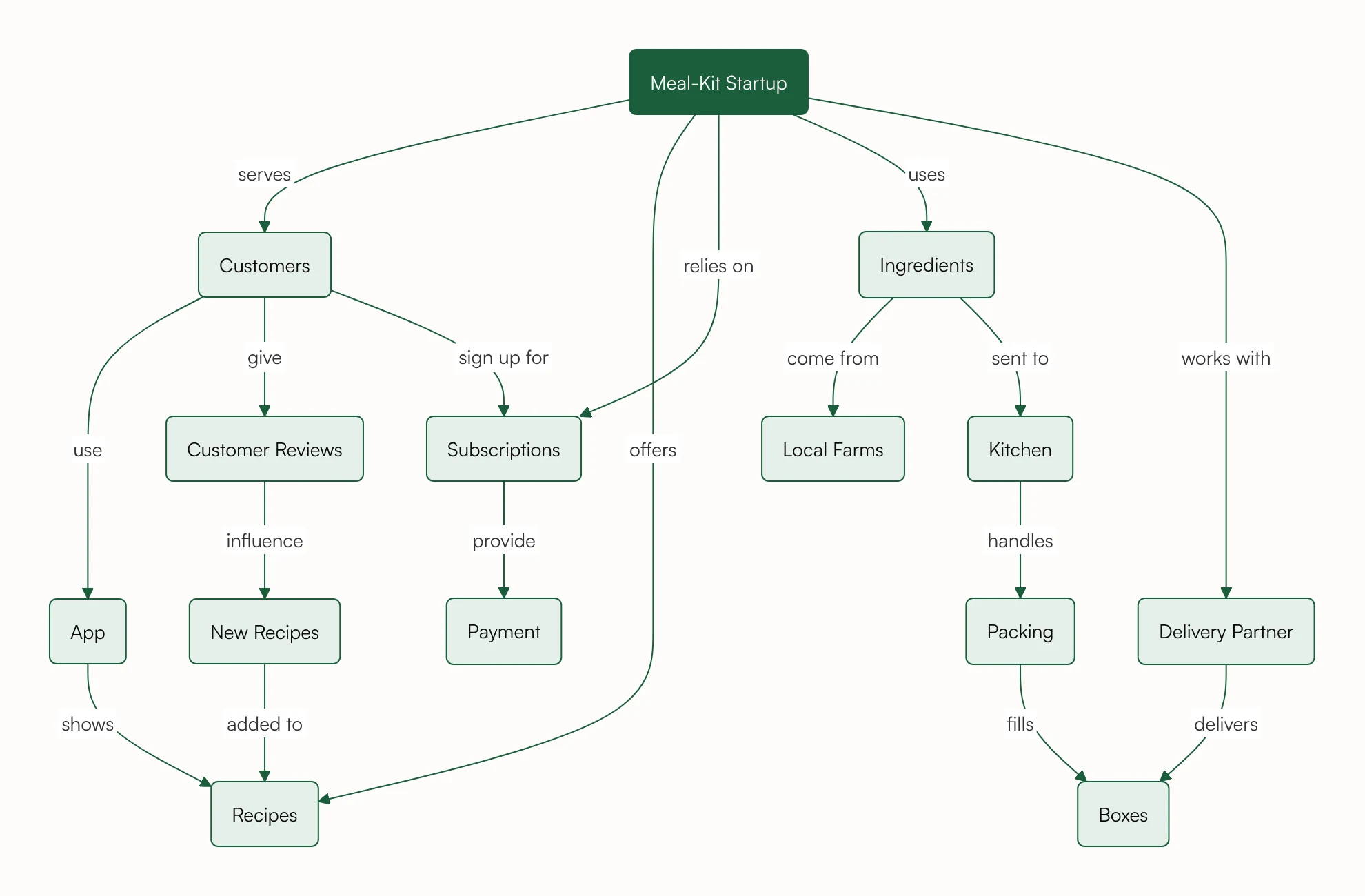
Concept maps are not only for school. This one maps a meal-kit startup from a short description: who it serves, what it offers, what it relies on and who it works with, down to local farms, the kitchen, packing and the boxes the delivery partner brings.
Following the arrows shows the whole loop: customers give reviews, reviews influence new recipes, and new recipes are added to the recipes the app shows. A map like this is a quick way to explain a business to a new hire or an investor.
画这张图用的文字
Our meal-kit startup: customers choose recipes on the app and subscribe weekly. We buy ingredients from local farms, pack them in our kitchen, and a delivery partner brings the boxes. Subscriptions pay for everything; customer reviews help us pick new recipes.
A mind map branches out from one central topic, and its lines carry no words: it is an outline drawn as a tree. A concept map can join any idea to any other, and every link says how the two relate, so it shows understanding rather than a list of subtopics.
Use a mind map to brainstorm or to outline a talk; use a concept map to explain how things work or to check that you understand a topic. For a branching outline, try Eidora's mind map maker.
How to Make Your Own Concept Map From an Example
Step 1: Pick the closest example. Start from the one whose topic or kind of text looks most like yours.
Step 2: Press Use this text. The concept map maker opens with the example's text in its box.
Step 3: Change the text. Type your own topic, or paste your notes, a paragraph or a list of terms. From your text, the map uses your ideas and your words; from a topic alone, it draws the map a teacher would draw.
Step 4: Press Generate. The map is ready in under 30 seconds. You can make one diagram a day without an account; a free account gets 16 credits to start and 4 free credits a day, and each map uses 4.
Step 5: Download or edit it. Download the map as a PNG or SVG, copy its Mermaid code, or press Edit in draw.io to move and restyle every box. Downloading needs a free account.
Tips for a Good Concept Map
One idea per box. Concepts are nouns or short noun phrases, such as "glucose" or "tectonic plates", never whole sentences.
A verb on every link. If the words on an arrow do not make a true sentence with the two boxes, the link is wrong or vague. Avoid "is related to": say how they relate.
General at the top, specific below. Put the main concept at the top and a few key ideas under it, then the details.
A few cross-links. Two to four links between branches are what make a concept map more than an outline. Many more turn it into a tangle.
Keep it small. Ten to twenty concepts is enough for one map. For a whole course, make one map per chapter.
Quick Answers About Concept Map Examples
What is an example of a concept map? A photosynthesis map is the classic example: the main concept at the top, what it needs and produces below it, and labelled arrows such as "needs" and "produces" between them. The 9 examples above cover science, history, writing and business.
What are the parts of a concept map? Concepts (the boxes), linking words (the words on the arrows), the hierarchy from general to specific, and cross-links between branches. A concept, a linking word and another concept together make one statement.
How many concepts should a concept map have? Usually 10 to 20. Eidora's concept map maker draws up to 25 concepts and 40 links per map.
Can I make a concept map from my notes? Yes. Paste your notes into the concept map maker: the map uses the ideas and words in your notes and adds no facts your notes do not state.
How do I make a concept map for free? Type a topic or paste your text into the concept map maker. You can make one diagram a day without an account and see the result.
Can I use these examples for my homework? Use them as a starting point. Press Use this text, put in your own notes or topic, and check the result against your course: a map you have built and checked yourself is the one that helps you learn.
Start From the Closest Example
Every good concept map starts with a question: how do these ideas connect? Find the example above that looks most like your topic, press Use this text and change it, or start from a blank box in the concept map maker.